
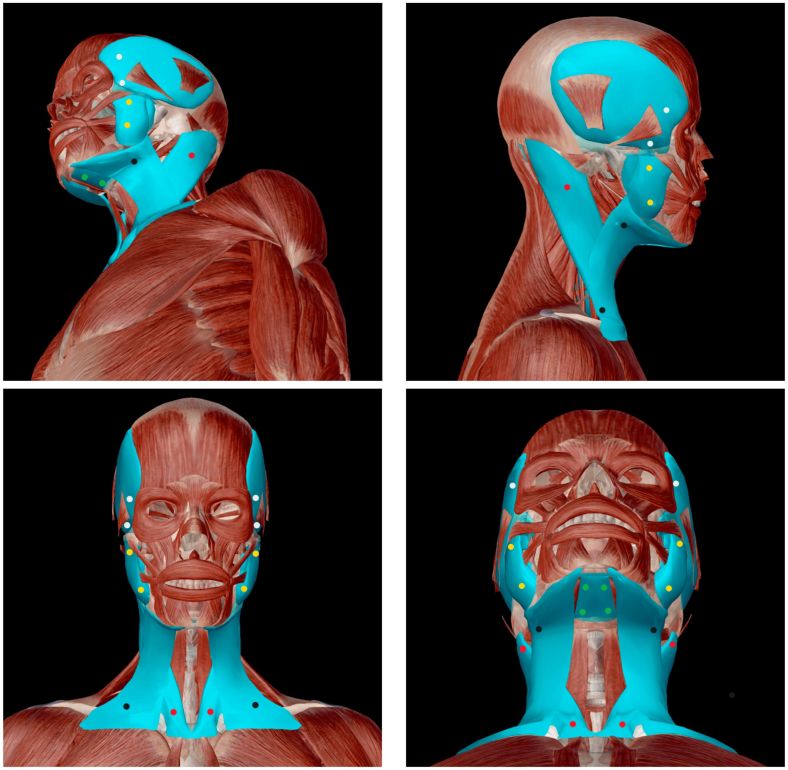
Nuove scoperte nel campo dei disturbi dell’Articolazione Temporo Mandibolare con l’uso di un Modello di Rete Anatomica.
Molte persone in tutto il mondo soffrono di disturbi dell’articolazione temporomandibolare (TMJ), ma diagnosi accurate e trattamenti efficaci rimangono sfuggenti e talvolta dipendono da decisioni soggettive. Questo articolo presenta una nuova metodologia non invasiva per valutare lo stato fisiologico del sistema masticatorio e identificare indicatori di rischio per una diagnosi precoce dei disturbi TMJ.
Attraverso lo studio della biomeccanica e delle proprietà viscoelastiche, i risultati rivelano l’importanza del tono muscolare e delle connessioni tra nodi specifici nel modello di rete anatomica composto da 20 nodi e 17 collegamenti.
La ricerca offre un approccio sistemico e quantitativo che arricchisce la comprensione di questi disturbi, andando oltre le osservazioni cliniche e i sintomi dei pazienti.
Campi, G.; Ricci, A.; Costa, N.; Genovesi, F.; Branca, J.J.V.; Paternostro, F.; Della Posta, D. Dynamic Correlations and Disorder in the Masticatory Musculature Network. Life 2023, 13, 2107. https://doi.org/10.3390/life13112107

Abstract
Background: Temporomandibular joint (TMJ) disorders, which affect millions of people worldwide, have multiple etiological factors that make an accurate diagnosis and effective treatments difficult. As a consequence, the gold standard diagnostic criteria for TMJ disorders remain elusive and often depend on subjective decisions.
Aim: In this context, the lack of a non-invasive quantitative methodology capable of assessing the functional physiological state and, consequently, identifying risk indicators for the early diagnosis of TMJ disorders must be tackled and resolved. Methodology: In this work, we have studied the biomechanics and viscoelastic properties of the functional masticatory system by a non-invasive approach involving 52 healthy subjects, analysed by statistical–physics analysis applied to myotonic measurements on specific points of the masticatory system designing a TMJ network composed of 17 nodes and 20 links.
Results: We find that the muscle tone and viscoelasticity of a specific cycle linking frontal, temporal, and mandibular nodes of the network play a prominent role in the physiological functionality of the system. At the same time, the functional state is characterised by a landscape of nearly degenerated levels of elasticity in all links of the network, making this parameter critically distributed and deviating from normal behaviour.
Conclusions: Time evolution and dynamic correlations between biomechanics and viscoelastic parameters measured on the different cycles of the network provide a quantitative framework associated with the functional state of the masticatory system. Our results are expected to contribute to enriching the taxonomy of this system, primarily based on clinical observations, patient symptoms, and expert consensus.
 Ferdinando Paternostro