NAUTA

Nuova Anatomia Umana Tridimensionale Atlante

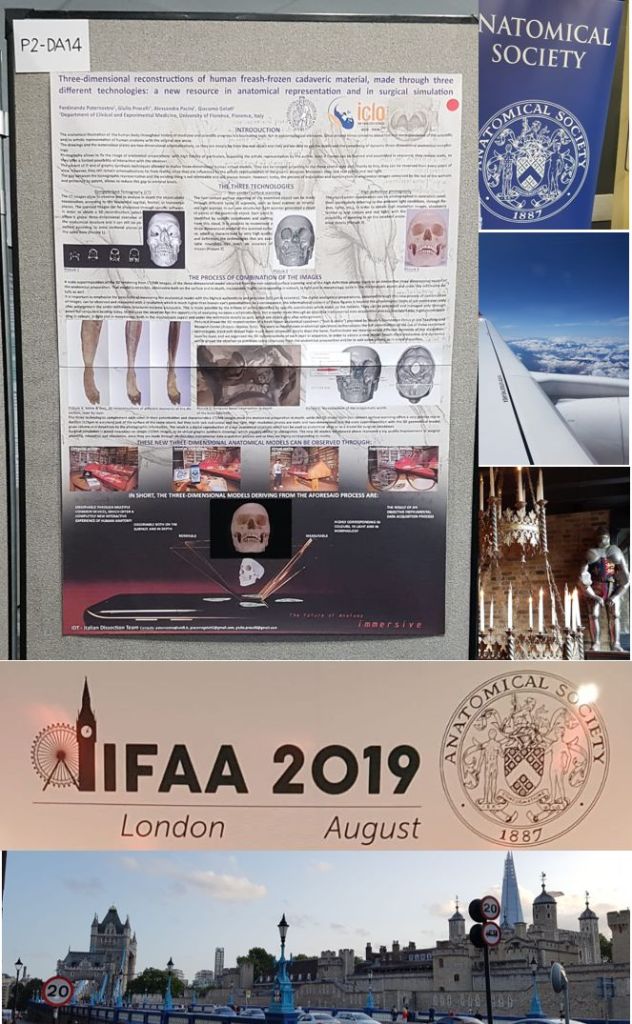
Il progetto, che nasce da una idea originale del Dott. Giacomo Gelati, consiste in un nuovo metodo di acquisizione e combinazione di immagini anatomiche, provenienti da tre diverse tecnologie, che consente di ricostruire digitalmente in 3D, in modo fedele e oggettivo, un preparato anatomico realmente esistente, rispettandone la morfologia, la luce, il colore e i rapporti dimensionali.
I modelli digitali tridimensionali così ottenuti possono essere ruotati ed orientati a proprio piacimento, misurati con precisione fino al µm, osservati al in superficie e in spessore, secondo piani di taglio frontali, sagittali o trasversali.

Oltre ad altre pubblicazioni, alla selezione come progetto IUF (Incubatore Universitario Fiorentino) e a comunicazioni a congressi internazionali, da tale progetto è nato anche un articolo sull’Italian Journal of Anatomy and Embyology, che sottopongo alla vostra attenzione e curiosità.

Gelati, G., Paternostro, F., Conti, A. A., & Orlandini, G. (2019).
The anatomical representation of the human body: From epistemological examples deriving from medical history to morphometric imaging performed with the laser scanner technique.
Italian Journal of Anatomy and Embryology, 124(1), 72-78.

https://oajournals.fupress.net/index.php/ijae/article/view/1699

The 19th Congress of the International Federation of Anatomists

Col cuore in mano …

Perchè un Anatomista settore è tendenzialmente sincero ?

Al di là della boutade … come si può studiare l’Anatomia macroscopica, topografica, clinica e chirurgica meglio che al tavolo settorio ?
ANA’ -TOMIA… studio per mezzo del taglio …

Oggi vi propongo una sezione del ventricolo destro, che ulteriormente arricchisce il Canale ANATOMIA PER TUTTI.

Per la Vostra curiosità e il Vostro studio ….

Anatomical study in the Western world before the Middle Ages: historical evidence

Although modern anatomy is commonly retained to begin in the XVI century, the roots of anatomical study in the Western world may be identified beforehand. An anatomical practice was present in the Western world well before the Middle Ages, starting in ancient Greece. Hippocrates of Cos (V-IV centuries B.C.) provided descriptions of the heart and vessels, and the so-called “Hippocratic Corpus” largely deals with anatomy. Aristotle of Stagira (IV century B.C.) was one of the first well-known scholars of the past to perform dissections of animals.

The anatomical interest of Aristotle contained a “physiological” background too, since he was convinced that all parts of human organisms had one or more specific functions. Galen of Pergamum (II century A.D.) was the performer of hundreds of dissections of animals, and he described a great number of anatomical parts of apes, dogs, goats and pigs. The anatomical system of Galen became a gold standard for medicine for more than a thousand years, and in the Middle Ages (V-XV centuries A.D.) the human anatomy that was taught and acquired in European universities remained based on Galenic anatomy.

In conclusion, Greek-speaking scholars between the IV century B.C. and the II century A.D. set the basis for the systematic dissection of animals and the comparative investigation of animal anatomical findings. These scholars also began to study the structures of the human body, interestingly taking into account the relationship between the macroscopical morphology of observed structures and their more evident functions.

Conti AA, Paternostro F. Anatomical study in the Western world before the Middle Ages: historical evidence. Acta Bio Med [Internet]. 2019Dec.23 [cited 2020Jul.20];90(4):523-5. Available from: https://www.mattioli1885journals.com/index.php/actabiomedica/article/view/8738

Ippocrate | Il blog di Ippocrate - Dott. Alfredo Marotta