
Perchè un Anatomista settore è tendenzialmente sincero ?
Al di là della boutade … come si può studiare l’Anatomia macroscopica, topografica, clinica e chirurgica meglio che al tavolo settorio ?
ANA’ -TOMIA… studio per mezzo del taglio …
Oggi vi propongo una sezione del ventricolo destro, che ulteriormente arricchisce il Canale ANATOMIA PER TUTTI.
Per la Vostra curiosità e il Vostro studio ….
Categoria anatomia

CROMATISMI QUADRITEMPORALI … E ILLUSIONI ANATOMICHE
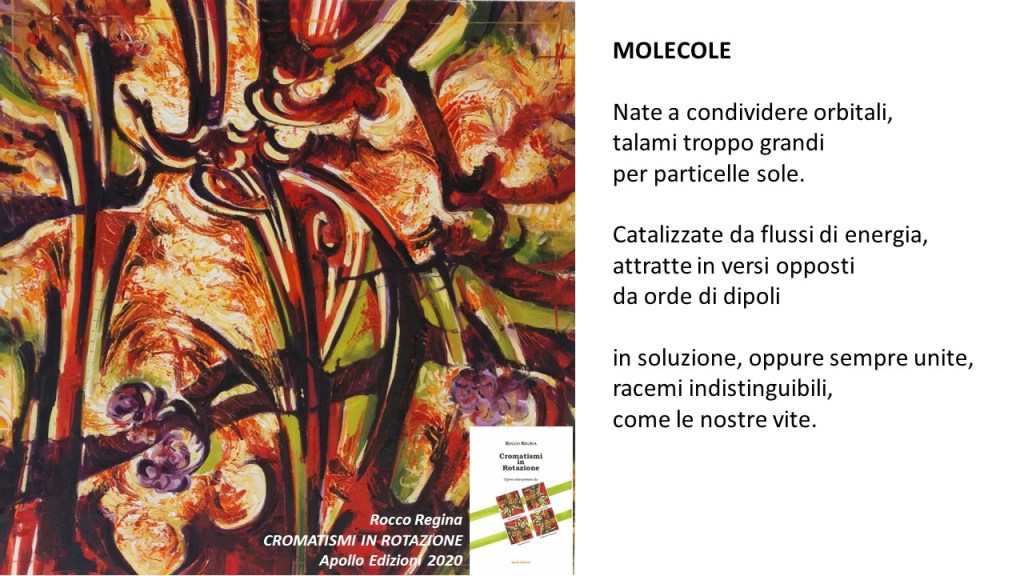
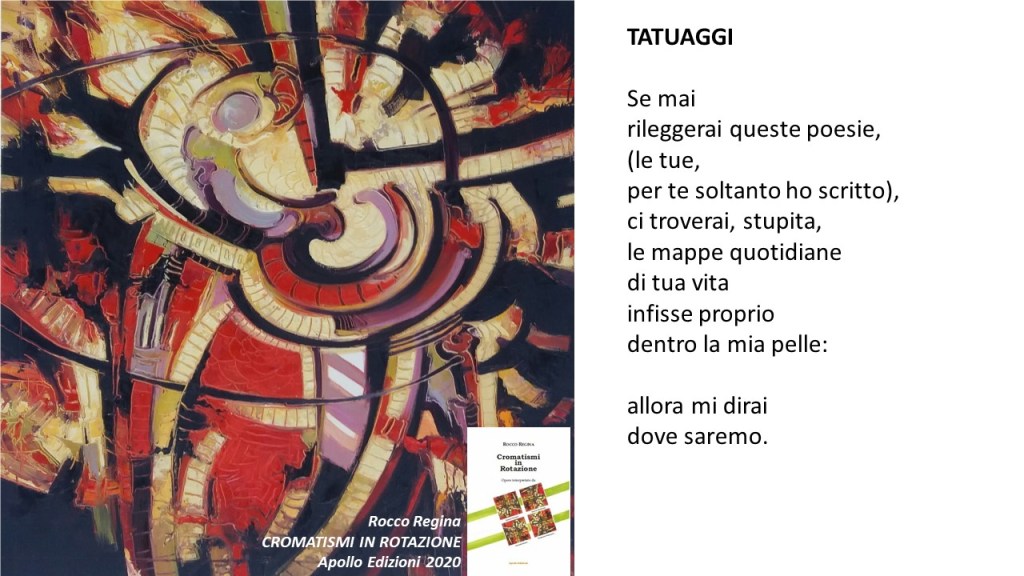
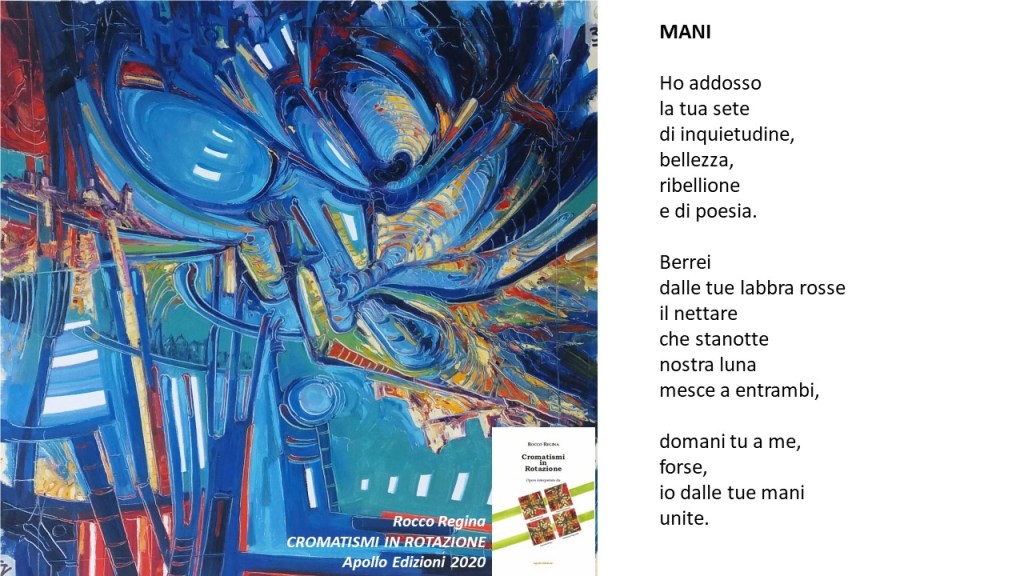
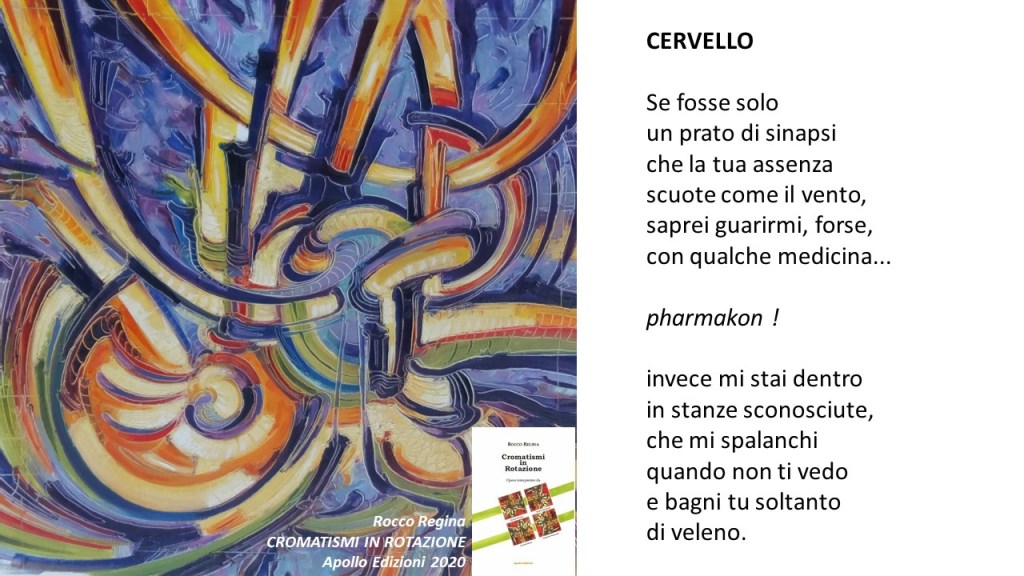
Prendi un grande Artista figurativo (Rocco Regina) che, dall’incontro con immortale e profondo Poeta (Francesco Maria Tarantino) cambia il suo stile e lo trasforma in un astratto dell’anima.
Prendi la straordinaria intuizione del Nostro che, dipingendo quadrati perfettamente ed emozionalmente quadrisimmetrici, chiede ai suoi estimatori di “cercare, raccontare e raccontarsi qualcosa” in ciascuna delle quattro possibili viste spazio-animo-temporali.
Prendi poi quattro amici (Rosanna Filomena, Gerardo Melchionda, Antonella Multari e chi vi scrive) a cui stimolare una lettura poetica di venti di queste meraviglie pittoriche, assegnando a ciascuno un lato da cui partire e lasciando libera penna e fantasia.
Prendi infine una illuminata casa editrice (Apollo Edizioni) che crede nel progetto e uno straordinario catalizzatore (Francesco Aronne) di intuizioni, meraviglie e sentimenti condivisi che sprona e incoraggia.
Cosi è nato CROMATISMI IN ROTAZIONE di cui vi invito a leggere il lancio su Faronotizie dello stesso Aronne, che è anche l’autore della prefazione.
Ho scritto per i “miei” venti lati ho scritto altrettante “illusioni” anatomiche.


















LEGGI ANCHE “RIFRAZIONI ROTAZIONISTE”
Anatomical study in the Western world before the Middle Ages: historical evidence
Although modern anatomy is commonly retained to begin in the XVI century, the roots of anatomical study in the Western world may be identified beforehand. An anatomical practice was present in the Western world well before the Middle Ages, starting in ancient Greece. Hippocrates of Cos (V-IV centuries B.C.) provided descriptions of the heart and vessels, and the so-called “Hippocratic Corpus” largely deals with anatomy. Aristotle of Stagira (IV century B.C.) was one of the first well-known scholars of the past to perform dissections of animals.
The anatomical interest of Aristotle contained a “physiological” background too, since he was convinced that all parts of human organisms had one or more specific functions. Galen of Pergamum (II century A.D.) was the performer of hundreds of dissections of animals, and he described a great number of anatomical parts of apes, dogs, goats and pigs. The anatomical system of Galen became a gold standard for medicine for more than a thousand years, and in the Middle Ages (V-XV centuries A.D.) the human anatomy that was taught and acquired in European universities remained based on Galenic anatomy.
In conclusion, Greek-speaking scholars between the IV century B.C. and the II century A.D. set the basis for the systematic dissection of animals and the comparative investigation of animal anatomical findings. These scholars also began to study the structures of the human body, interestingly taking into account the relationship between the macroscopical morphology of observed structures and their more evident functions.
Conti AA, Paternostro F. Anatomical study in the Western world before the Middle Ages: historical evidence. Acta Bio Med [Internet]. 2019Dec.23 [cited 2020Jul.20];90(4):523-5. Available from: https://www.mattioli1885journals.com/index.php/actabiomedica/article/view/8738

An application of the graph theory to the study of the human locomotor system
Ferdinando Paternostro, Ugo Santosuosso, Daniele Della Posta, Piergiorgio Francia
The study of the relationships between the different structures of the human locomotor system still raises great interest. In fact, the human body networks and in particular the “myofascial sys-tem network” underlie posture and movement and new knowledge could be useful and applied to many fields such as medicine and prosthetics. The hypothesis of this study was to verify the possibility of creating a structural network representing the human locomotor system as well as to study and describe the relationship between the different structures considered.
The graph theory was applied to a network of 2339 body parts (nodes) and 7310 links, representing the locomotor system. The open source platform software Cytoscape was used for data entry (nodes and links) as well as for debugging. In addition, the “NetworkAnalyzer” plugin was used for the descriptive statistics of the network obtained. In order to achieve a better rendering, the results of the network parameters gained were then imported into Gephi graph platform. At the end of this procedure, we obtained an image of a human being in an orthostatic position with a precise distribution of the nodes and links. More specifically, “the shortest pathways analysis of the network” demonstrated that any two randomly selected nodes on the network were connect-ed by pathways of 4 or at most 6-8 nodes. Moreover, the Edge Radiality Distribution analysis was carried out in order to define how a single node is functionally relevant for other nodes: the probability distribution ranged from 0.4 to 0.77. This indicates that the majority of nodes tend to be functionally relevant for the others, but none of these is predominant. As a whole, the Cluster Coefficient (0.260) demonstrates that the network is neither random nor “strongly organized”.
IJAE Vol. 124, n. 3: 353-363, 2019
https://oajournals.fupress.net/index.php/ijae/article/view/11664/11094

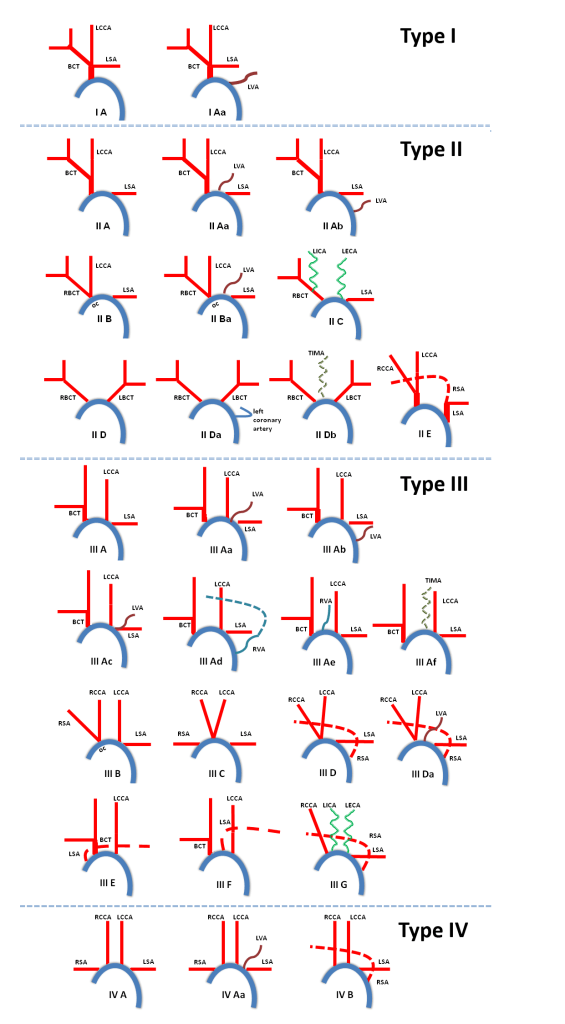
Aortic arch branching pattern variation: its incidence on a 20030 cases review
Caryn Recto, Maria Boddi, Jacopo Junio Valerio Branca, Gabriele Morucci, Alessandra Pacini, Massimo Gulisano, Ferdinando Paternostro
Variations in the branching pattern of the aortic arch are clinically relevant because of the direct influence that their presence can have on the success of cardio-vascular procedures, neck or thorax surgery, trauma management or intensive care. In most cases these anatomical variations are asymptomatic and considered clinically benign, but some particular aortic branching patterns have been associated with surgical complications or with vascular diseases in non-surgical patients.
The main objective of this work was to study the frequency of variation of the aortic arch branching pattern in a wide and varied population on the basis of literature reports.
The aortic arch branching pattern of 20,030 cases reported by 40 anatomical or radiological studies were analyzed. 84,52% of the studied population had a three branches pattern and 14,65% had a two branches pattern.
The four primary arteries were seen arising directly from the aortic arch in 0,81% of the cases and only 0,02% had them all arising from a common trunk.
IJAE Vol. 124, n. 1: 5-15, 2019
https://oajournals.fupress.net/index.php/ijae/article/view/1692/1690
Renal artery variations: a 20.782 kidneys review
Caryn Recto, Antonino Marcello Pilia, Riccardo Campi, Jacopo J.V. Branca, Alessandra Pacini, Ferdinando Paternostro
Introduction: vascular anatomy variations are important in academic, clinical and surgical are-as as well as nephrology, urology, oncological and vascular surgery, among others. The main objective of this review is to know the real prevalence of multiple renal arteries in a wide, mul-tiethnic population. Secondary objectives are to establish the prevalence of early branching of the renal artery and the prevalence of these variations in left and right kidneys.
Methods: this study analyzes the renal arterial anatomy of 20.782 kidneys from 64 anatomical and radiologi-cal studies.
Results: Multiple renal arteries (MRA) were present in 19,95% of the total kidneys, in number of 2 to 6 arteries arriving to the hilum. The most frequent number of MRA was 2 renal arteries (89,48%), followed by 3 (9,31%), 4 (1,06%), 5 (0,02%) and 6 (0,005%). This last one being found in only one kidney. Reported data on the lateralization of the MRA are rather poor, and among these no side’s predilection was found: MRA were found in 49,83% on the right side and 50,17% of left kidneys. Early branching patterns were described in only one third of the published data, being present in 11,4% of the total kidneys from those data (corresponding in 4,23% of right kidney cases and in 4,52% of left kidney cases; 2,66% had no right/left infor-mation).
Discussion: the most difficult part was to merge the results from the different studies due to the heterogeneity of their descriptions. A universally accepted medical nomenclature is needed in order to allow a more precise lecture and transmission of results in clinical practice. Renal anatomical variations have clinical and surgical implications in renal transplantation, cor-rectable hydronephrosis, ablation treatment for refractory hypertension or endovascular recon-structions and should be taken into account by every physician.
IJAE Vol. 124, n. 2: 153-163, 2019
https://oajournals.fupress.net/index.php/ijae/article/view/10776/10696

Number of kidneys with MRA and its prevalence.
 Ferdinando Paternostro